

Carpet Area vs Built-Up vs Super Built-Up Area: The 1,000 Sq Ft That Isn’t
Picture two cousins in Pune who each bought a “1,000 sq ft” flat this year. At Diwali they compare notes. One has fitted a six-seater dining table and a study nook. The other is still wondering where the second sofa will go.
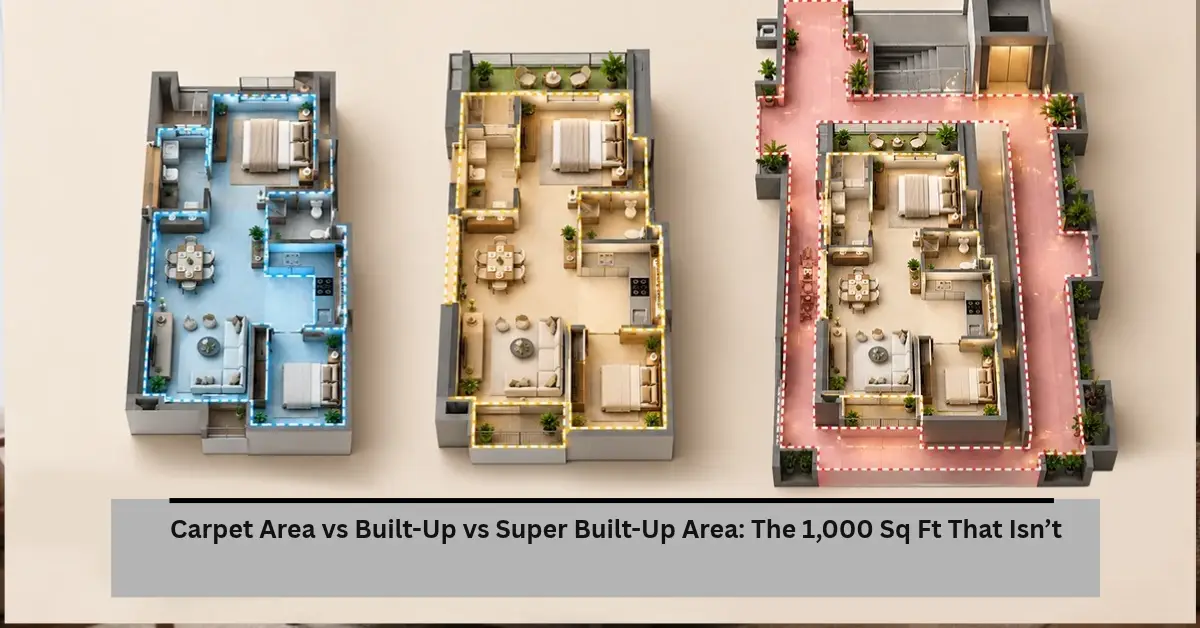
Nobody lied. They were just measured differently. Carpet area, built-up area and super built-up area are three ways of counting the same flat, and the number on the brochure is often the biggest one. Here is how to read all three, so you know what you are really buying.
Three numbers in one line
The carpet area is what you live in. A built-up area is what gets built around you. Super built-up area is that, plus your share of the building.
Each number is larger than the last, and only the first is entirely yours.
Carpet area: the part you can furnish
The Real Estate (Regulation and Development) Act, 2016 defines carpet area in Section 2(k) as the net usable floor area of an apartment. It leaves out external walls, service shafts, an exclusive balcony or verandah and an exclusive open terrace. It includes the internal partition walls.
So this is your living room, bedrooms, kitchen and bathrooms. If you want to know whether your sofa, bed and dining table will fit, this is the number to trust.
Built-up area: carpet plus the walls and balcony
Built-up area adds the thickness of the walls, plus attached spaces such as balconies and ducts. It is usually about 10 to 20 percent larger than carpet area, depending on the design. It is useful as a reference, but you cannot put a wardrobe inside a wall.
Super built-up area: the number on the poster
Super built-up area, often called saleable area, adds a proportionate share of shared spaces such as lobbies, staircases, lift shafts and sometimes amenities. The gap between it and the carpet area is the loading factor. Before RERA, this was often the figure that decided how a flat was priced and advertised.
Loading commonly adds 25 to 35 percent and can go higher. A bigger loading does not guarantee better amenities, so never compare two projects on this number alone.
Same flat, three different numbers
These figures are illustrative and are not taken from any project. Say a flat has a carpet area of 650 sq ft. With walls and a balcony, the built-up area is about 750 sq ft. With a share of common areas, the super built-up area is about 880 sq ft.
Now say the flat costs 80 lakh. In a super built-up area, that is roughly 9,100 per sq ft. On carpet area, it is roughly 12,300 per sq ft. Same flat, same price, and a rate that looks 25 percent lower on paper.
Three myths worth retiring
“A bigger number means a bigger home.” Not necessarily. A large super built-up figure can simply mean a high loading.
“A lower rate per sq ft means a better deal.” Only if both rates use the same yardstick. Compare the carpet area, or you are comparing apples with oranges.
“The balcony is part of the carpet area.” Under RERA, an exclusive balcony, verandah or open terrace is not part of the carpet area. If it is charged for, it should be stated separately.
Apartments, row houses and plots count differently
The measuring stick also changes with the type of home. Apartments are compared on carpet areas. In a row house, duplex or townhouse, private terraces and gardens usually sit outside the carpet area, so ask how they are measured and priced. A plot is sold by plot area, and the idea of carpet area does not apply until you build.
This matters at a project like Kutumb, where apartments, row houses, duplexes, townhouses and NA serviced plots sit within the same community. Before comparing two homes, make sure you are comparing the same kind of number.
The two-minute check before you book
- Ask for the carpet area of the exact unit, in square feet.
- Look up the project on MahaRERA using its registration number and confirm that figure.
- Divide the total price by the carpet area. That is your real rate per sq ft.
- Ask which items, such as balconies, terraces or parking, are charged separately.
- Read the agreement to see how any change in carpet area is handled.
Do this for each home on your shortlist and the comparison becomes simple. It takes a few minutes, and it can save you from a decision you would regret for years.
Beyond the numbers
Two flats with the same carpet area can feel nothing alike. One wastes space on long corridors while the other turns every square foot into room. Light, ventilation, ceiling height and how rooms connect all shape daily life, and none of them appears in an area figure.
So use carpet area to compare fairly, then walk through the home and picture your own routine in it. Where does the morning chai happen? Where does the homework get done? A good layout answers those questions without being asked.
Ready to see the difference in person?
Our project pages carry the MahaRERA registration numbers, so you can verify details yourself. If you would like help reading a floor plan, our team is happy to walk you through it. Explore our projects at naiknavare.com/projects or reach us through naiknavare.com/contact-us.